Lisa Walker
Managing Partner, Global Industrial Practice, USA | Global Remit

Why breadth has become the decisive leadership differentiator in robotics and automation — and what boards, CEOs, and talent leaders must do about it now.
The era of the deep specialist-turned-leader is not over. But it is no longer sufficient, and the gap between the two is widening faster than most leadership teams realize.
For decades, robotics and automation companies built their pipelines on a simple logic: master one domain, accumulate credibility, rise. Hardware engineers became VPs. Controls specialists became CTOs. Depth was the currency, and the path was linear.
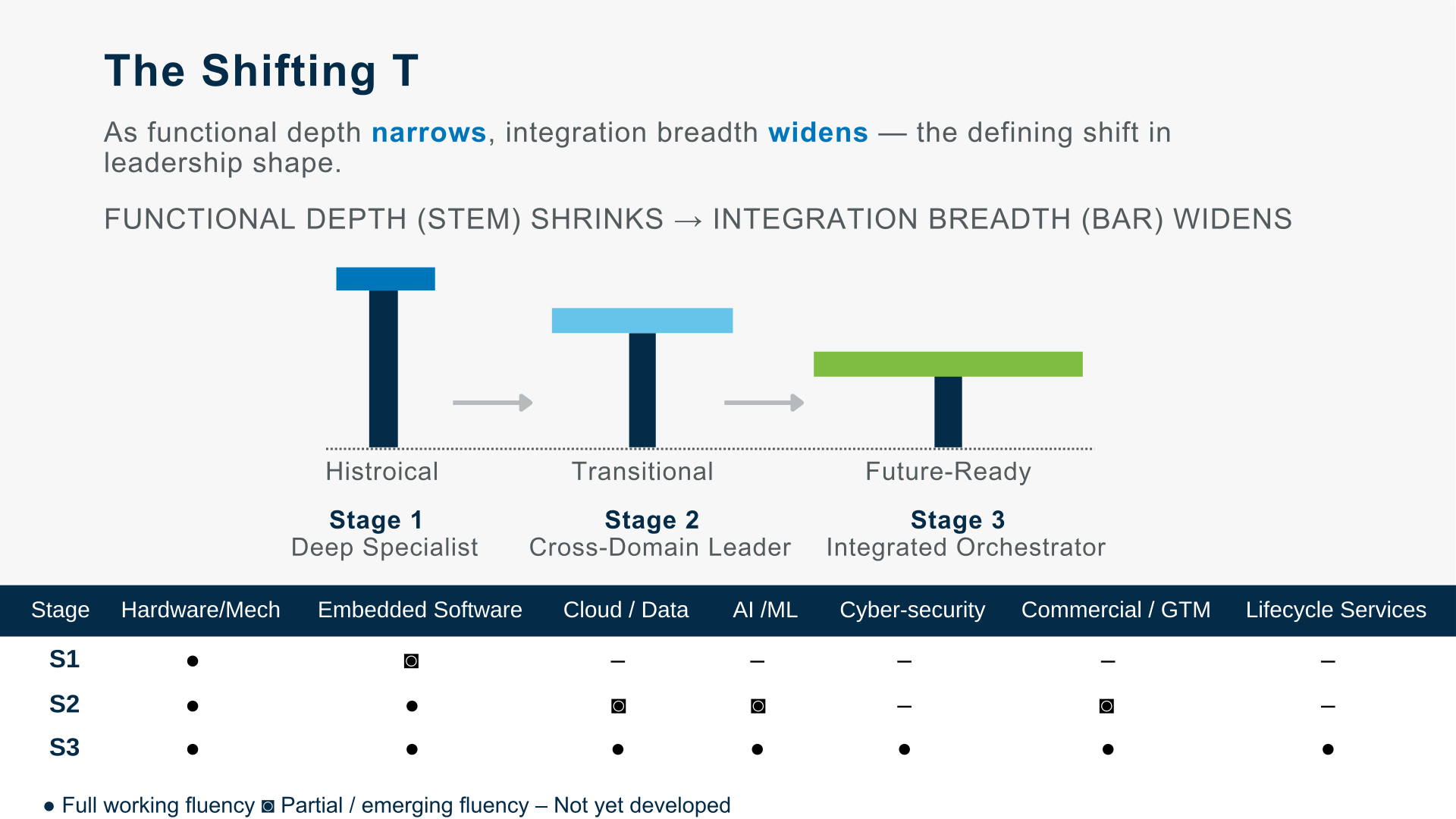
The industry that built its leadership pipeline on functional depth now competes on integration. Companies that understand this will pull ahead. Those that don’t will feel it in product cycles, commercial execution, and talent retention simultaneously.
Roughly 30–35% of top-performing technology CEOs hold engineering degrees — a proportion growing steadily as digital transformation raises the premium on technical literacy at the top. Engineers bring systems thinking, product orientation, and data-driven judgment that generalist leaders often lack. But the era of single-domain advantage is over: the stack — hardware, embedded software, cloud, AI/ML, cybersecurity, commercial models — has become deeply interdependent. No single functional expert can hold the whole system in their head. Value is created at the intersections, and the intersections have no natural owner under legacy organizational structures.
DHR Global’s research points to an emerging model — the Integration Orchestrator: leaders with genuine working fluency across 3–4 adjacent domains, capable of making consequential trade-off calls at speed, with system-level ownership of outcomes rather than functional deliverables alone.
Most companies are behind, and the deficit is structural, not incidental.
Companies that continue optimizing for functional excellence while their environment demands system-level integration will accumulate a talent deficit that compounds with every product cycle and every leadership transition.
This is not a talent management issue. It is a competitive strategy question with a talent expression. Companies that crack the integration orchestrator model operate with faster decision velocity where technology intersects with commercial execution. In a sector this dynamic, first movers in the leadership model shape markets and define categories before competitors recognize what’s happening. Deep specialists remain essential — in individual contributor roles, not general leadership. Boards and CEOs who conflate technical depth with integration fluency are staffing for yesterday’s competitive environment.

Audit your leadership architecture
Map your top 20 leaders against the full technology and commercial stack. How many have carried meaningful accountability outside their functional home domain? Where the answer is “few” or “none,” you have a structural problem: not a pipeline problem. That distinction matters, because structural problems require structural solutions.

Redesign your development pathways
High-potential leaders need cross-functional exposure before they fully arrive in their domain: not as a
reward for getting there. Build deliberate rotation across hardware, software, commercial, and service roles
into your leadership architecture. Assign P&L or system-level accountability earlier than feels comfortable.
The discomfort is the point.

Raise the bar on external search
Most search processes are optimized to find functional pedigree, not integration fluency. Push harder:
require evidence of cross-domain trade-off decisions under pressure, accountability across organizational
boundaries, and a demonstrated track record of connecting technical and commercial priorities. If your
search partner can’t tell the difference, find one who can.

Make this a board-level conversation
The Shifting T is a competitive strategy issue, not an HR agenda item. Boards that govern leadership
architecture as seriously as they govern capital allocation will ask: does our executive team have the
integration fluency to execute our technology strategy? If that question hasn’t been on the agenda, put it
there. The window to get ahead of this is narrowing.
In this series of Executive Briefs, DHR Global examines the leadership challenges reshaping
automation, electronics, and robotics:
– Brief 1: From Automation to Intelligence — how the basis of competitive advantage is shifting from
hardware performance to integrated system leadership
– Brief 2 (this issue): The Shifting T — why breadth has become the decisive leadership differentiator, and what
companies must do about it
– Coming: The new roles emerging to integrate software, hardware, data, cloud, and AI; how leaders are
allocating their time differently
Robotics and automation companies are in the middle of a structural shift, from fixed-function hardware to connected, AI-enabled platforms that sense, learn, and optimize in real time. The technology conversation is well covered. The leadership conversation is not.
Managing Partner, Global Industrial Practice, USA | Global Remit
Managing Partner
Managing Partner, European Industrial Practice, Germany | Austria | Europe
Managing Partner, Asia Pacific Industrial Practice; Managing Partner, Singapore