Jennifer Skylakos
Managing Partner, Infrastructure & Energy

Infrastructure and energy funds are managing increasingly complex portfolios. What were once predominantly stable, yield-driven assets have evolved into platforms and operating businesses that require active ownership to deliver returns. At the same time, internal team structures have not evolved at the same pace.
Across the market, investment teams continue to span underwriting, governance, and value creation responsibilities, a model that reflects how funds were historically built, but does not consistently support how performance is delivered today.
The consequence is structural: responsibility for portfolio performance is distributed across multiple individuals, with no single function clearly accountable for driving outcomes. When ownership is shared in this way, execution becomes inconsistent, intervention is delayed, and value creation depends on individual effort rather than a repeatable model.
This paper explores why this model has persisted, where it breaks down, and how leading funds are redesigning their organizations as they scale.
At the core of this issue is a conflation of three fundamentally different roles:
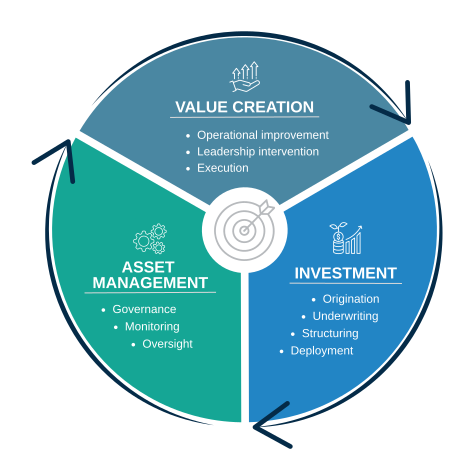
These functions require different capabilities, different time commitments, and different ways of working. Investment professionals are trained to assess risk, structure transactions, and deploy capital. Those capabilities do not translate directly into operational execution or organizational transformation.
In many funds, however, these responsibilities are treated as interchangeable. The problem is that the scope of what is required has expanded well beyond what any single role can realistically deliver across a growing portfolio.
“When everyone is loosely responsible for portfolio performance, no one is truly accountable for it. That ambiguity has a cost. It is not always visible in a single quarter, but it compounds. The funds that are gaining the real advantage are those acting deliberately about where ownership sits.”
Historically, this model worked. Infrastructure investing was built around assets requiring limited operational intervention and performance was driven by capital deployment, financial structuring, and governance and not hands-on execution within the business. Teams were lean, portfolios were smaller, and bundling underwriting, oversight, and performance responsibility into a single role was both efficient and effective.
That context has changed. Portfolios today increasingly include operating businesses and platform investments requiring sustained engagement across management, operations, and strategy. Capital is no longer inexpensive, and fundraising demands a clearer articulation of how returns are generated.
LP expectations reflect this shift. Where high single-digit returns were once acceptable, investors are now underwriting mid-teens outcomes, with greater scrutiny on how those returns will be delivered. Value must be created during the hold period, not simply captured at exit.
Yet many organizations continue to operate with structures designed for an earlier model. The result is a structural mismatch: portfolios have become more operationally complex, and value creation has become more central to performance, but team structures have not kept pace. What was once a strength has become a constraint.
The model does not fail at a single threshold. Pressure builds gradually as portfolios scale.
Common inflection points include:
Internally, senior investors become increasingly stretched, balancing transaction activity with portfolio issues. Junior team members absorb responsibilities they are not equipped or incentivized to manage. Portfolio challenges are identified but not consistently addressed. Externally, LP scrutiny reinforces this pressure, as investors focus on understanding who is accountable for delivering portfolio performance.
“Funds tend to believe they can manage within the existing structure for longer than they can. By the time the strain becomes visible, the organization is already operating beyond its capacity to support the portfolio effectively.”
The cost of unclear ownership is rarely immediate, but it compounds over time.
The most common consequences are:
Collectively, these factors result in lost value, not through a single event, but through the accumulation of missed opportunities and delayed action.
There is no single organizational model that defines best practice. Approaches vary by strategy, asset composition, and stage of development, but the funds that address this challenge effectively tend to follow a consistent set of principles.
They start by defining where value is created within the portfolio, not conceptually, but asset by asset. This means identifying the specific constraints to performance, whether operational, leadership-related, commercial, or regulatory.
From there, they build capability with intent. Rather than broad or generic mandates, they define the expertise required to address those constraints precisely, whether through internal asset management leadership, operating partners with sector depth, or senior advisers with specific functional relevance.
Roles are introduced with clear scope and expectations. Responsibilities are explicitly defined, decision rights are aligned, and accountability is structured to support consistent execution. Collaboration with the investment team remains essential, but it does not come at the expense of ownership.
These funds are also disciplined in how they attract external talent. Experienced operators assess opportunities as rigorously as funds assess them, evaluating the credibility of the team, the clarity of the mandate, and how their expertise will be used in practice. Funds that recognize this create the conditions for a productive and durable partnership from the outset.
Funds often approach this question through a headcount or cost lens. In practice, the issue is usually one of prioritization and role definition.
As investment teams become increasingly stretched across origination, execution, portfolio oversight, and value creation responsibilities, the most common response is not to define a distinct capability, but to hire another investment professional who can absorb “more of everything.” Typically, this takes the form of an additional VP or Principal.
In the short term, this can relieve pressure; however, it rarely addresses the underlying issue of ownership and accountability within the portfolio.
Two consistent triggers tend to force the conversation:
The challenge is timing. Most funds recognize the need for greater specialization or clearer division of responsibilities, but deprioritize structural changes while deal activity and fundraising remain the immediate focus. As a result, action is often delayed until the existing structure can no longer absorb the pressure. At that point, decisions become reactive rather than deliberate.
“There’s a pattern where funds wait, then move quickly, but without defining the role. When that happens, the hire doesn’t solve the problem because the problem was never clearly defined.”
A more effective approach begins with identifying where responsibilities are overlapping, where capacity constraints are emerging, and what capability is genuinely required. From there, funds are better positioned to define the appropriate role, establish how it integrates with the broader team, and create clear accountability across investment management, portfolio oversight, and value creation activities.
As funds scale, organizational structures need to evolve alongside increasing portfolio complexity, operational intensity, and value creation demands. Below is a lens that funds can use to assess how internal teams and functions may need to develop over time, and at what stage greater specialization and clearer accountability typically become necessary.
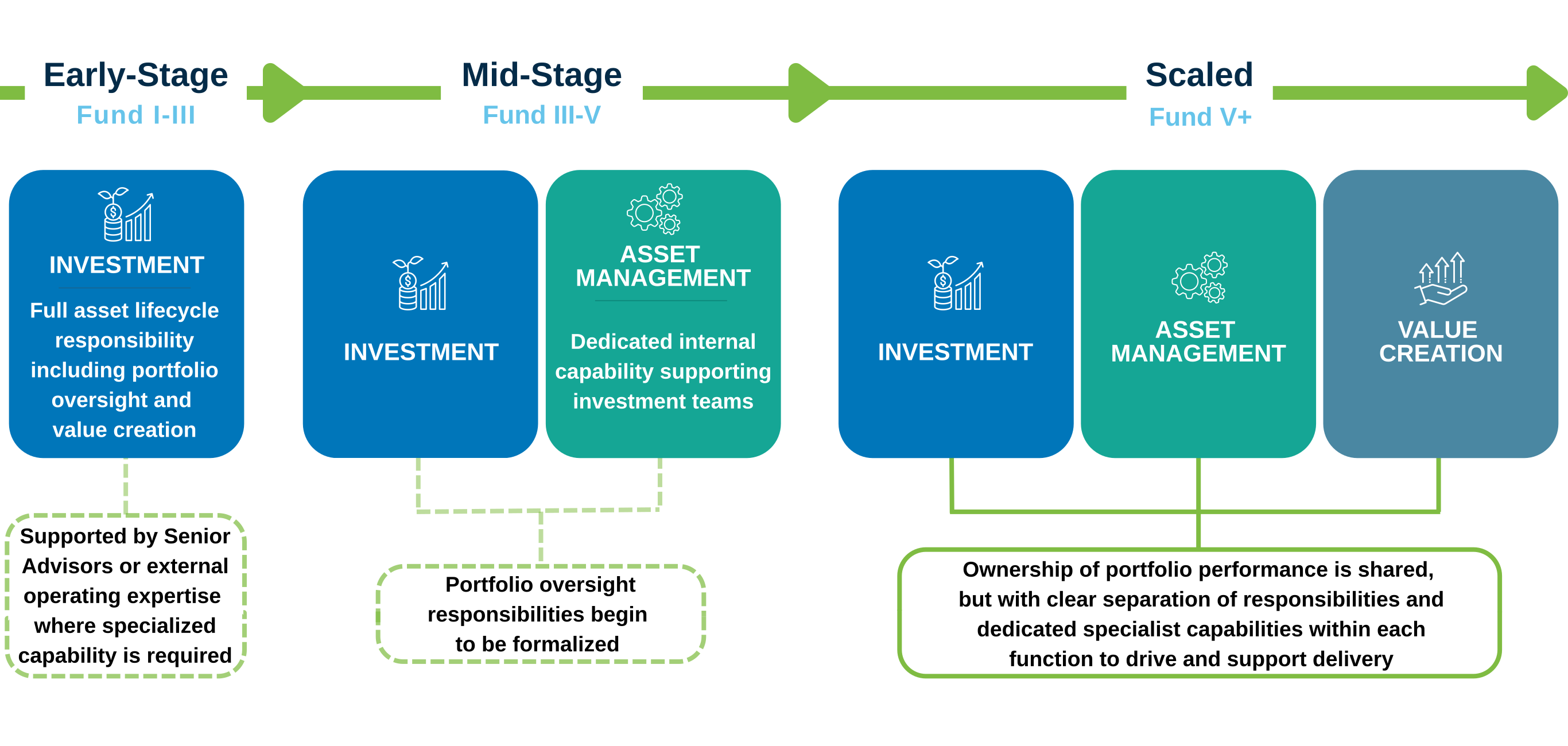
A critical consideration at each stage is ensuring that asset management and value creation do not remain embedded indistinctly within the investment function. Clarity of ownership is what allows each function to perform.
“There comes a point where the same team structure can no longer support the scale, complexity, and operational demands of the portfolio. As that gap widens, performance increasingly depends not just on investment execution, but on having clear ownership and the right capability around the assets.”
Infrastructure and energy funds operate in an environment where performance depends on execution within portfolio companies. The question is not whether value creation matters – it is who owns it.
Funds that define roles clearly, align capabilities to portfolio needs, and establish explicit accountability will be better positioned to deliver consistent performance. Role clarity is not an organizational preference. It is a competitive advantage.
DHR Global’s Sustainable Infrastructure & Energy Practice partners with infrastructure and energy investors to build the leadership teams and organizational structures required to deliver performance.
We work across private equity, credit, and secondaries strategies, supporting funds, asset managers, and portfolio companies across infrastructure, energy transition, and digital infrastructure. Our approach combines executive search with organizational advisory, helping clients define how their teams should be structured, then building the capability required to execute.
We bring deep connectivity across the infrastructure and energy ecosystem, with long-standing relationships across GPs, LPs, and portfolio company leadership teams. A key area of our work is supporting funds to design and build operating partner and senior adviser capability, defining where external expertise is required, structuring those roles effectively, and accessing senior operators, technical experts, and sector specialists aligned to portfolio needs.
We typically partner with funds at moments of change: strategy launches, platform scaling, or increasing LP scrutiny, ensuring organizational design and leadership capability are aligned to how value is created.